
The Reason Why
Born From a Legacy of Care. Driven by a Mission of Justice.
What is our story?
It starts with family. I was in middle school when my grandmother, Helyn, had her first heart attack. She was a healthcare worker for decades, eventually letting her nursing license lapse but continuing to work in a nursing home in various positions—from the laundry room to the kitchen, to lead activities coordinator.
She would take time to feed the slower nursing home residents long after mealtime was over, long after the nursing staff had taken everyone else back to other rooms and activities. She knew a stroke, dementia, heart attack, or other conditions meant it could take hours to just eat a cup of mashed potatoes. She wanted to be sure those residents who needed the most attention ate something that day and had company for a short while. Sometimes the staff who were more appropriate for those duties just did not have the time or patience—sad, but true.
One day, Helyn was not feeling well. She collapsed at work and was rushed to the ER. After a few surgeries, when she returned to work, her job as the head of activities was handed to someone younger. Her crafts, tools, supplies, paints, and everything else she purchased out of pocket were all redistributed.
“The lock that was on her personal cabinet, just like her job, was gone, and she was forced to retire unexpectedly early.”
She never pursued legal action for several personal reasons. Her daughter—my biological mother—worked for attorneys for much of her life, so Helyn had potential access to a network of lawyers if she wanted it. We were taught that attorneys are advocates. I knew the cost was only one part of why she did not want to go to court. At the time, I did not understand how stressful, time-intensive, anxiogenic, and exhausting the process could be, especially following a serious and scary health event that could be triggered again
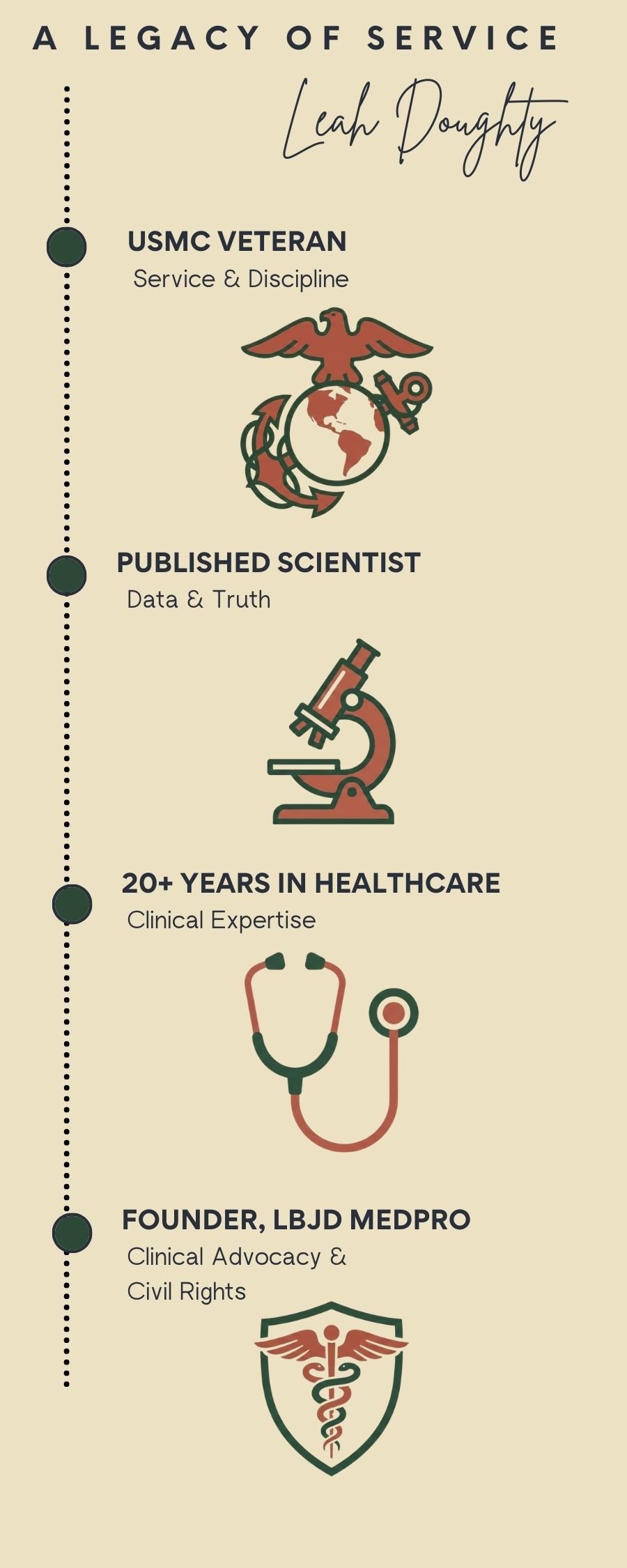
Who am I? I have worked in various positions in healthcare over decades, and am currently a practicing physician assistant (PA-C) in the Midwest. I knew from a very young age that I wanted to pursue science and medicine, following my grandmother’s kindness, compassion, and appreciation for treating the most vulnerable among us with the respect they deserve.
I also embody intersectionality, as I belong to a lot of protected demographic groups. “I’m a lot of other”—a racial minority, LGBTQAI+, over 40 years of age, coming from low-income socioeconomic roots, and living with severe, progressive, disabling medical conditions. Those disabling conditions are military service-connected from my time serving the nation as an active duty female Marine (the fewer and the prouder, Semper Fi).
Being different allows me to think differently. While I have been attacked for every piece of my existence, I have simultaneously marched forward and continued to think outside the box. As a result, I am a published scientist, teacher, nurturer, advocate for the patient and the underdog, and a community member, among the many hats I wear. I have broken several cycles of unhealthy habits, freeing myself and others from negative life patterns. I am extremely resourceful, great with problem-solving, and quite passionate about helping those who are left vulnerable.
Those same traits that make me a dynamic employee and an amazing provider for my patients attract attention and make me a target at work. Regardless of my accomplishments and dedication, I have faced multiple accounts of illegal workplace bullying, discrimination, harassment, retaliation, interference with, or outright denial of disability accommodations, and much more in healthcare environments.
These issues are common and can present as micro- or macroaggressions that chip away at the target daily. The historical reasons for putting civil rights into written law are numerous, because employers regularly mistreat workers and break the law at every opportunity that suits them. Then they hire attorneys when they get caught. Human resources and other company representatives often lie and twist around facts to make the victim seem like a “bad” employee, “poor team player”, or “unprofessional”. Companies gaslight workers, creating false performance reports to manufacture a paper trail, eventually leading to termination for cause. If you report these outrageous behaviors to the appropriate governing agency, like the EEOC or DOL, the toxicity of the work environment gets even worse.
The vast majority of these victims’ stories are not told to the public for a variety of reasons. It might make you look like a problematic employee. You could be blacklisted. You signed a nondisclosure agreement. The past employer might sue you, or they know your colleagues at the new jobs you are interviewing for. The audience might not believe you. You really want and need a fresh start. These illegal occurrences have been amplified in the current sociopolitical atmosphere, and recent government policy changes are revoking civil protections. These actions tend to help the aggressor and worsen the impact on the victim.
But you do not have to be a ‘helpless’ victim. Instead, you can be an empowered individual, taking control of your own future and navigating this skillfully.
I founded LBJD Med Pro to offer support to healthcare employees in these difficult, ugly, and complicated situations. We have been helping under-represented people to solve problems, take action against their employers, and position themselves better to move their careers forward. Today, we want to extend support to all healthcare professionals. You may decide to try to save your current employment and/or fight for your promotion or fair pay. Or you might decide to cut ties, count your losses, and move on, like Helyn did. It is your decision. We support you and help you advocate for yourself while choosing your own journey.
Maybe if Helyn had the support, coaching, and advocacy that she needed, her story could have been very different. These life experiences as a whole are our company’s roots.
The Anonymous Chronicles: Turning Trauma Into Tales
We can’t change what happened to Helyn, but we can change how your story is told.
In healthcare, “The Machine” relies on you being too exhausted or terrified of retaliation to speak out. That is why we created The Anonymous Chronicles. We take your painful experiences, strip away your identifying details, and weaponize the satire. We protect the heroes, honor the patients, and put the HR administrators exactly where they belong: in the punchline.
Want to see how we translated my grandmother’s tragedy into a satirical takedown of corporate healthcare? Or are you ready to submit your own run-in with a “Chad” or a “Brenda”?